

A revocable living trust keeps the plan working during life
A living trust holds instructions for managing property while you are living, if you become incapacitated, and after death.
The simple mechanism
Assets are re-titled from your individual name into the trust’s name. When the trust owns the asset, there may be nothing in your individual name for a court to control.
You keep control
You can usually serve as grantor, trustee, and beneficiary while competent. You can buy, sell, invest, change, or cancel a revocable trust, and the transfer is generally treated as a non-event for federal income-tax purposes.
The four people and roles
The trust team is easy to understand once each role is separated.
Grantor
The grantor creates the trust and can generally change its terms while the trust is revocable. A person, couple, or other owner may create a trust.
Trustee and successor trustee
The trustee manages trust assets now. You can often be your own trustee, while a named successor trustee steps in at incapacity or death; a trusted person, professional, or corporate trustee may serve.
Beneficiaries
Beneficiaries receive trust property under the instructions. The plan can delay or stage distributions for children, grandchildren, or a beneficiary who needs protection.
Funding the trust
A trust only controls the property transferred into it or connected to it by a coordinated beneficiary designation.
Common funding steps
- Re-title Rhode Island real estate and coordinate treatment of out-of-state property.
- Change appropriate bank and investment accounts into the trust’s name.
- Review life insurance and other beneficiary designations.
- Assign personal property that does not have a formal title.
- Leave certain retirement accounts outside the trust when the tax or plan rules call for it.
Why the details matter
An unfunded trust can contain excellent instructions and still have no authority over an asset. An attorney may intentionally exclude an asset, so the funding plan should be reviewed asset by asset.
Incapacity under the trust
A named successor trustee can manage trust property according to your instructions if you cannot manage it yourself.
A measured transition
The trust can say who determines incapacity and what kind of medical examinations are required. If you recover, you automatically resume control under the trust’s terms.
Why a power of attorney still matters
A trust does not own every asset and does not replace health care documents. A durable financial power of attorney can fill gaps, while a health care proxy or advance directive addresses medical decisions.
A trust is not a magic document
A living trust can help avoid probate and court control, but it must be drafted, signed, funded, and maintained correctly.
The pour-over will
A pour-over will catches property left outside the trust and can nominate a guardian for minor children. Those assets may still need probate before they are transferred into the trust.
Review it over time
Review the trust after marriage, divorce, a birth, a death, a move, a major asset change, or a change in the law. Beneficiary forms and deeds should be reviewed with it.
You can handle the organization now, or leave courts and attorneys to reconstruct it later when you cannot.
One free copy, no obligation
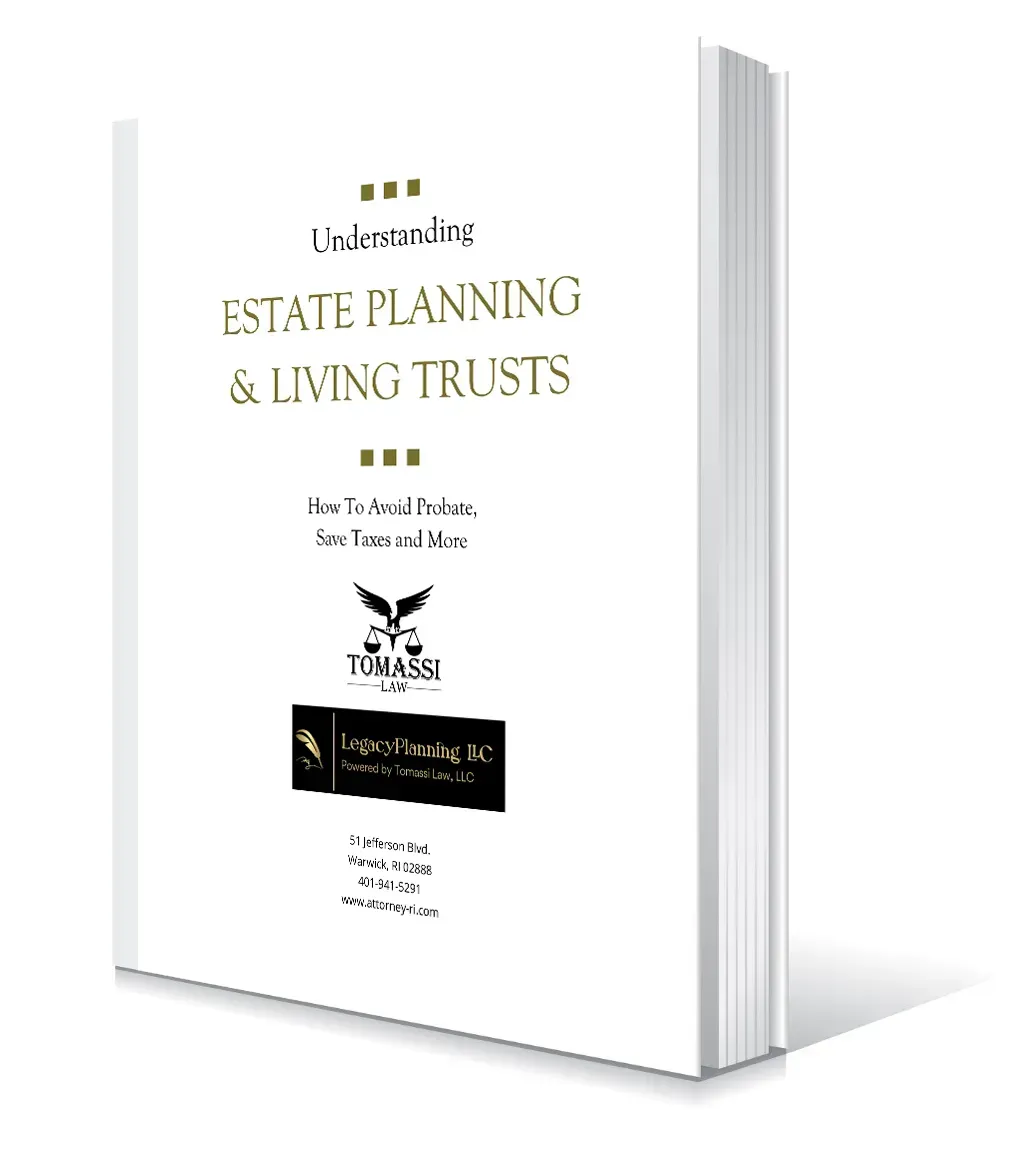
A plain-English guide for Rhode Island families, published by Tomassi Law, LLC.
A practical place to begin
Understanding Estate Planning & Living Trusts
How To Avoid Probate, Save Taxes and More
This free booklet explains, in plain English, how estate planning works, how living trusts can help families avoid probate, and how thoughtful planning can help protect assets. It is general information for Rhode Island families—not legal advice—and it does not create an attorney-client relationship.
Read more about living trusts, probate, and estate administration, or contact the firm with a question about your own situation.
Requests are handled by the office Monday–Friday, 9:00am – 5:00pm; Saturdays by appointment only. You can also call 401-941-5291.
Your information is used only to send the booklet.